Sub-Micron Stability, Stray-Light Suppression & Laser-Grade Metrology
From multi-axis CNC ultra-precision machined kinematic mirror mounts to diamond-turned telecentric lens barrels and laser collimator prism assemblies — BoValley manufactures optomechanical components engineered for thermal drift immunity, zero wavefront distortion, and high-vacuum photonics compliance.
Case 01 | Kinematic Optical Mirror Mount (Ultra-Stable Tip/Tilt Gimbal Cell)
Multi-Angle Visual Gallery

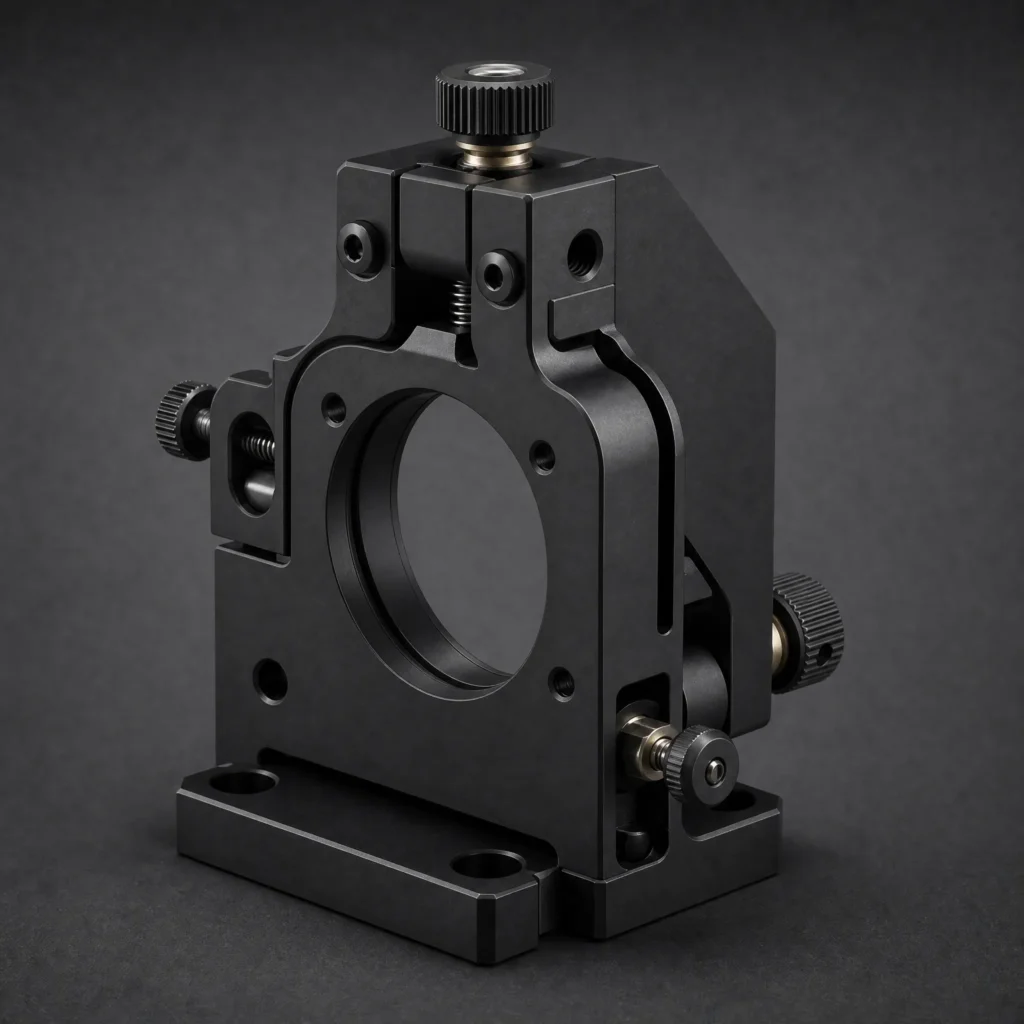

1. Manufacturing Process & Material Selection
- Core Process: High-Precision Multi-Axis CNC Milling Center + Sub-Zero Cryogenic Stabilization (−80∘C stress relief) + Wire EDM Micro-Slitting for Flexure Hinges + Non-Reflective Optical Matte Black Anodizing (MIL-A-8625 Type II Class 2, Deep Absorption <1% reflectance).
- Material Grade: Stress-Relieved Aluminum Alloy 6061-T651 / Low-Expansion Invar 36
- Engineering Justification: Near-zero residual stress prevents long-term temporal drift (<1 μrad/year); Invar 36 variants provide near-zero coefficient of thermal expansion (CTE≈1.2×10⁻⁶/K) across laser cavity operating ranges.
- Tolerances & Optical Precision: Kinematic carbide ball contact pad flatness ≤0.003 mm; differential adjustment thread concentricity ≤0.005 mm; mirror seating face flatness λ/4 ≈150 nm to eliminate induced wavefront distortion.
2. Structural Features & Manufacturing Challenges
- Monolithic Wire EDM Flexure Spring Hinges (Zero-Backlash Pivot):
- Challenge: Monolithic flexure hinges require micro-slits with leaf spring web thicknesses down to 0.45 mm. Micro-notches or residual EDM recast layer induces fatigue micro-fractures and thermal drift under adjustment cycles.
- Solution: Utilized ultra-fine wire EDM (0.05 mm brass wire) with low-energy multi-cut skimming to eliminate the brittle recast layer, followed by micro-electropolishing to achieve stress-free flexure elasticity.
- Deep Non-Reflective Matte Black Optical Surface (Stray Light Suppression):
- Challenge: Laser alignment requires zero specular reflection from chamfers and sidewalls; standard industrial anodizing leaves reflective shiny edge facets that generate ghost laser flares.
- Solution: Applied proprietary chemical micro-etching prior to sulfuric acid anodizing, impregnating organic deep black dyes sealed with nickel acetate to guarantee optical matte light trapping across 400–1100 nm wavelengths.
3. Real-World Applications
- Ultra-Fast Laser Cavities & Interferometer Beam Steering: Providing sub-arcsecond tip/tilt angular adjustment for titanium-sapphire and fiber laser resonators.
- Semiconductor Photolithography Alignment Stations: Housing precision dielectric turning mirrors with high thermal stability under continuous UV exposure.
Case 02 | Multi-Element Telecentric Optical Lens Barrel (Machine Vision & Metrology Housing)
Multi-Angle Visual Gallery
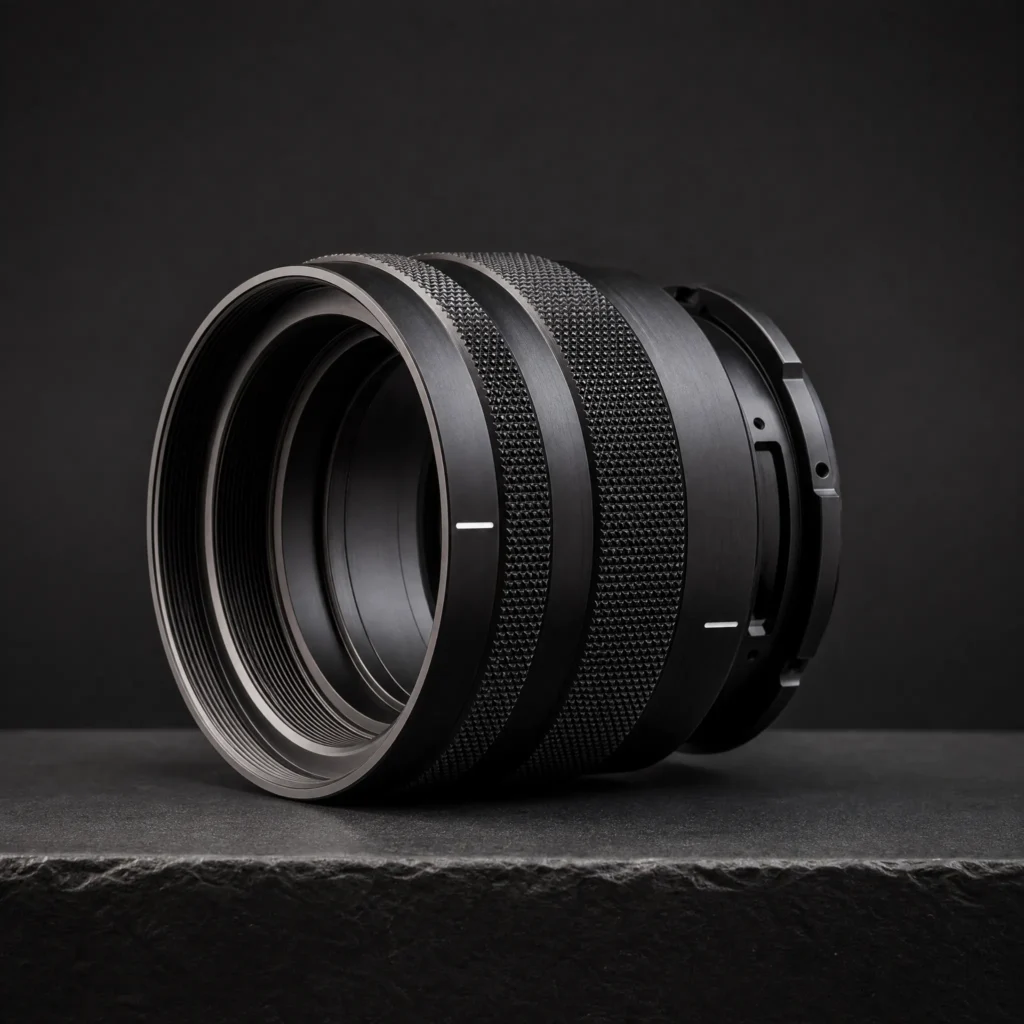
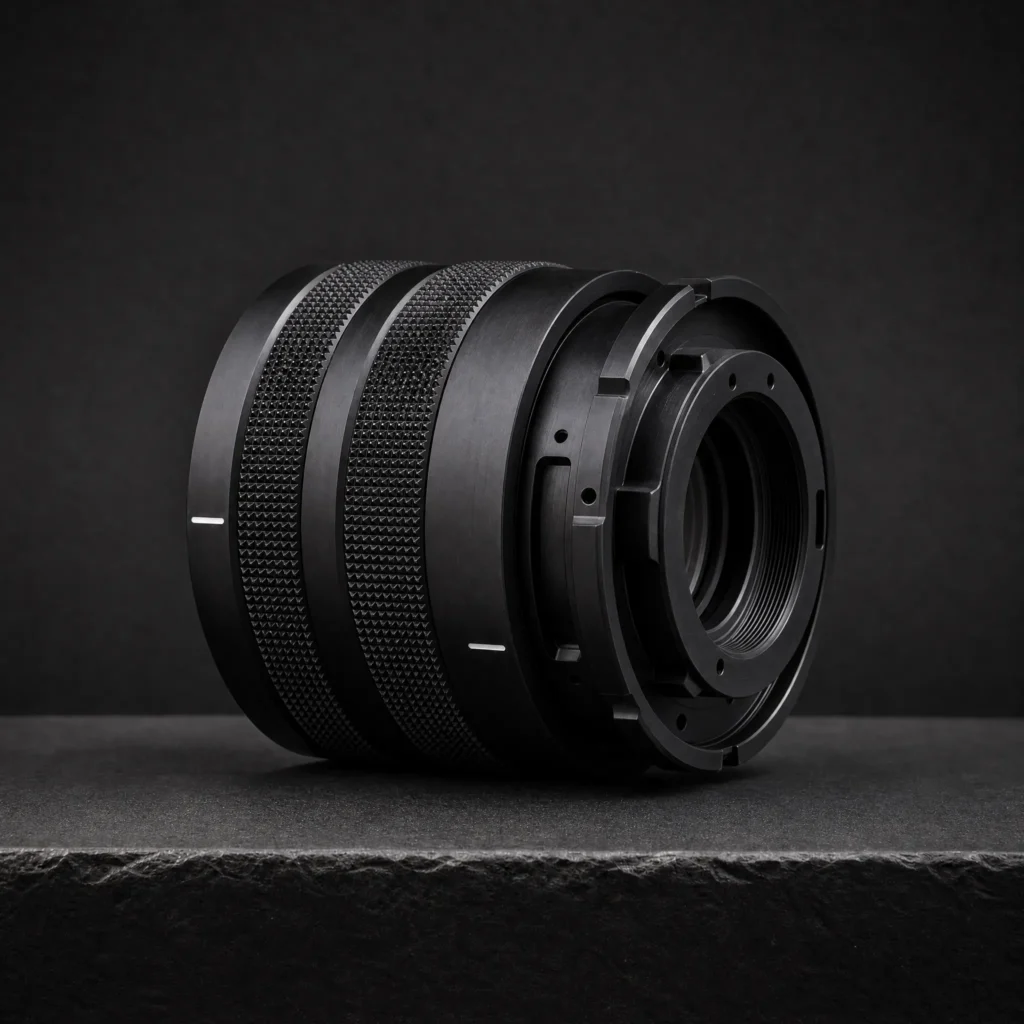
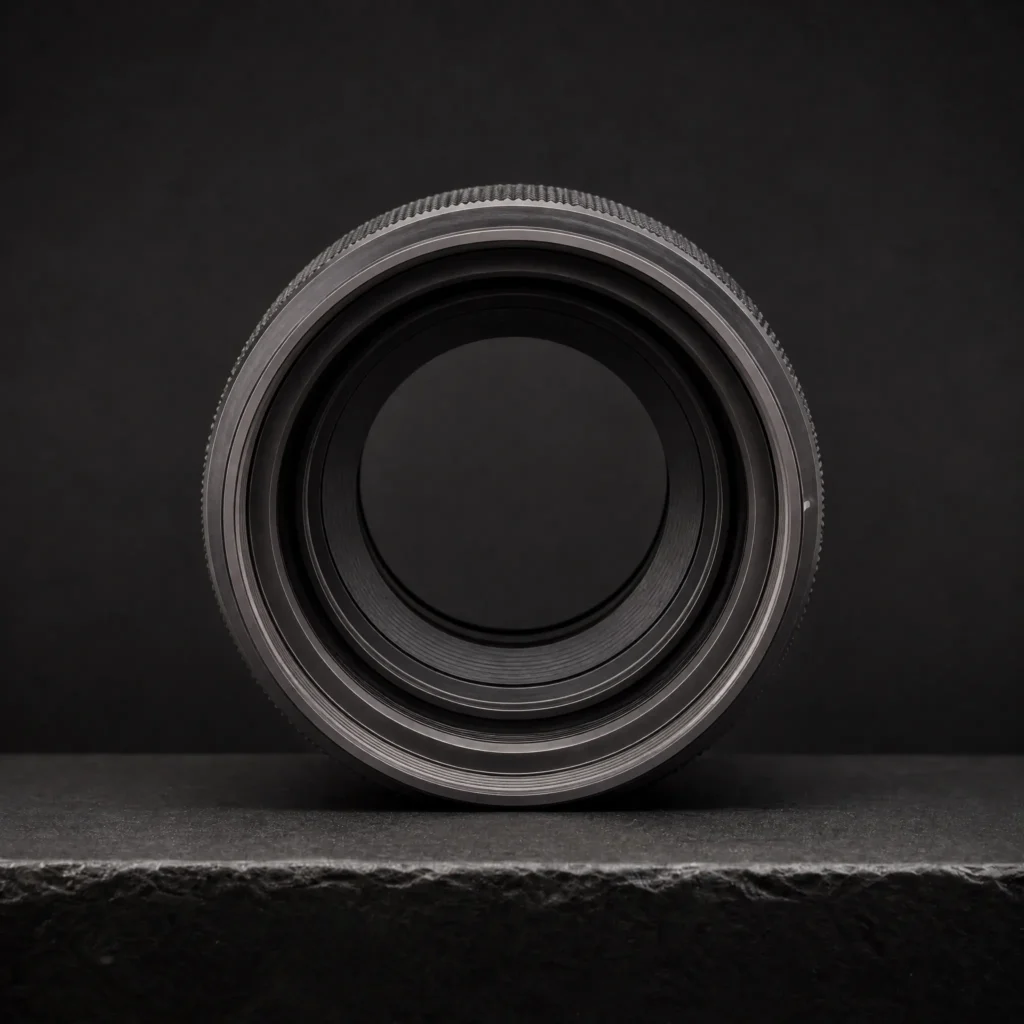
1. Manufacturing Process & Material Selection
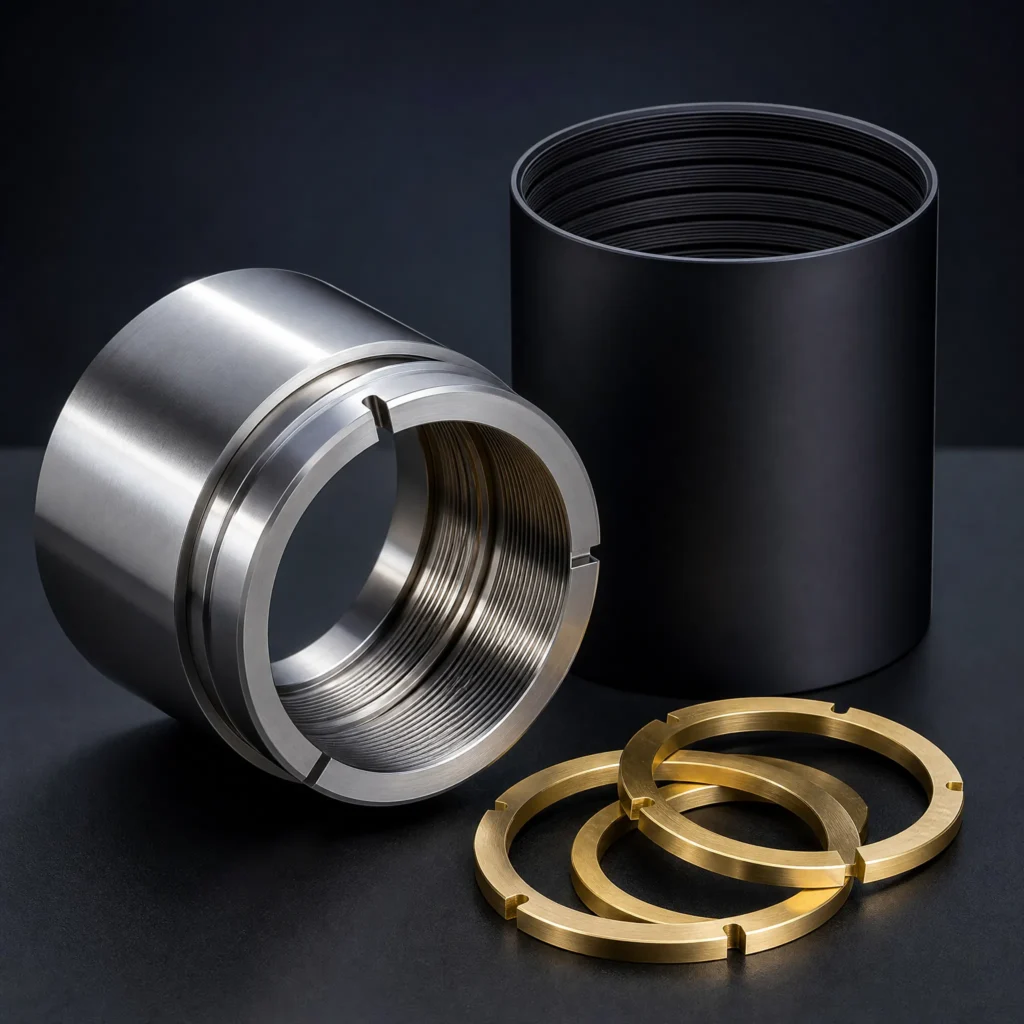
- Core Process: High-Precision Multi-Tasking Turn-Mill Compound Center + Single-Point Diamond Turning (SPDT for lens seats) + Precision Fine-Pitch Thread Whirling + Internal Anti-Glare Micro-Thread Flocking + Hard Matte Black Anodizing.
- Material Grade: Aviation Aluminum Alloy 7075-T651 / Free-Cutting Brass C3604
- Engineering Justification: Free of micro-porosity to maintain optical axis stability; brass/aluminum combinations balance thermal dissipation, structural rigidity, and smooth fine-pitch thread engagement without galling.
- Tolerances & Concentricity: Multi-step internal lens-cell shoulder runout ≤0.003 mm; optical axis tilt ≤30 arcsec; internal retaining ring fine thread pitch tolerance held to class 4H/5H.
2. Structural Features & Manufacturing Challenges
- Multi-Shoulder Internal Concentricity Across Deep Bore (>180 mm):
- Challenge: Telecentric machine vision lenses incorporate 6 to 12 separate optical lens doublets. Any eccentricity between consecutive internal lens seating steps causes optical coma, astigmatism, and field-of-view vignetting.
- Solution: Turn-mill compound center executed all internal stepped seating diameters, front retaining threads, and rear bayonet flange datums in a single continuous chucking setup, eliminating reclamping runout entirely.
- Internal Anti-Reflective Micro-Baffle Threading (Stray Light Trapping):
- Challenge: Glancing light rays reflecting off internal barrel walls degrade MTF (Modulation Transfer Function) contrast. Internal surfaces require ultra-fine knife-edge light baffles (0.15 mm pitch).
- Solution: High-frequency threading tools grooved micro-serrated optical baffle profiles directly into internal walls, treated with flocking matte black anodizing to completely absorb off-axis glare.
3. Real-World Applications
- Automated Optical Inspection (AOI) Telecentric Lenses: Delivering zero-perspective-error dimensional gauging for high-density smartphone PCB and wafer inspection.
- Biomedical Fluorescence Imaging & Flow Cytometry: Housing multi-spectral objective lenses with zero internal fluorescence background noise.
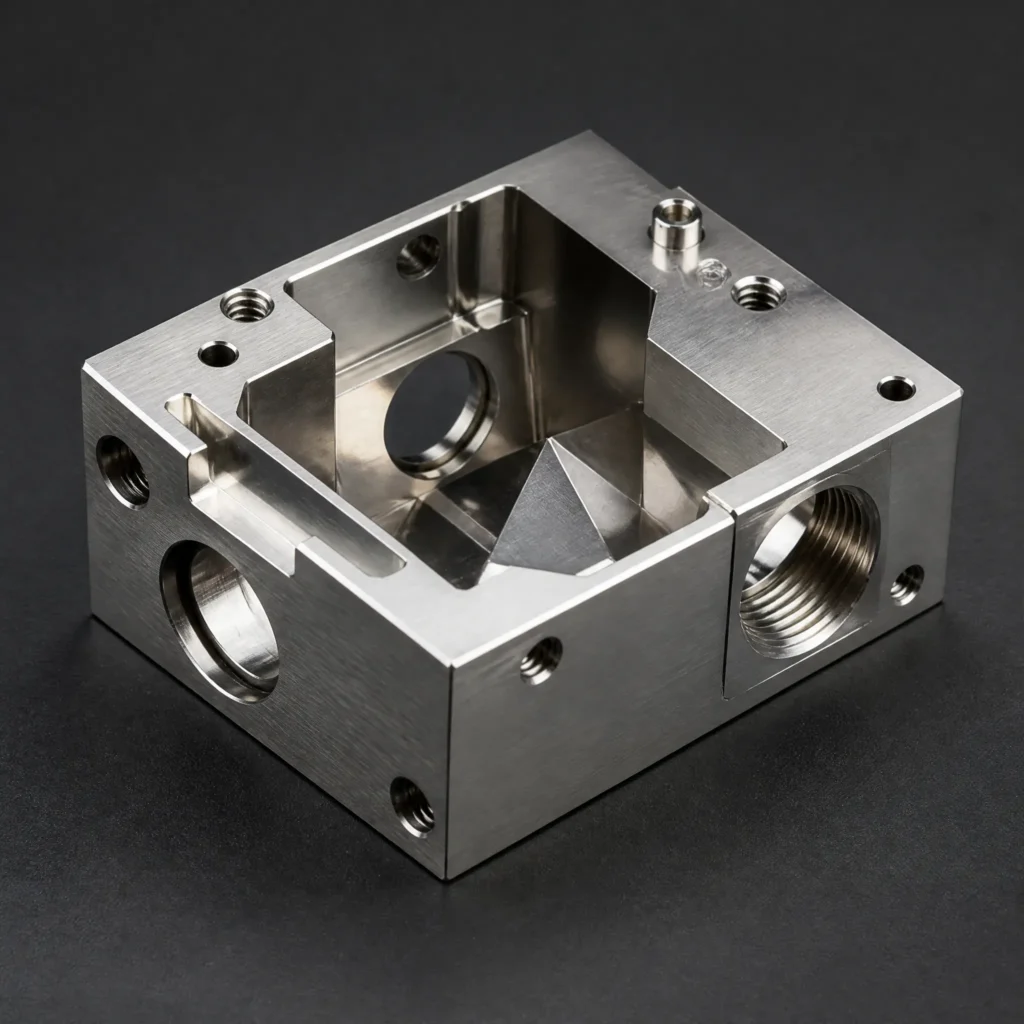
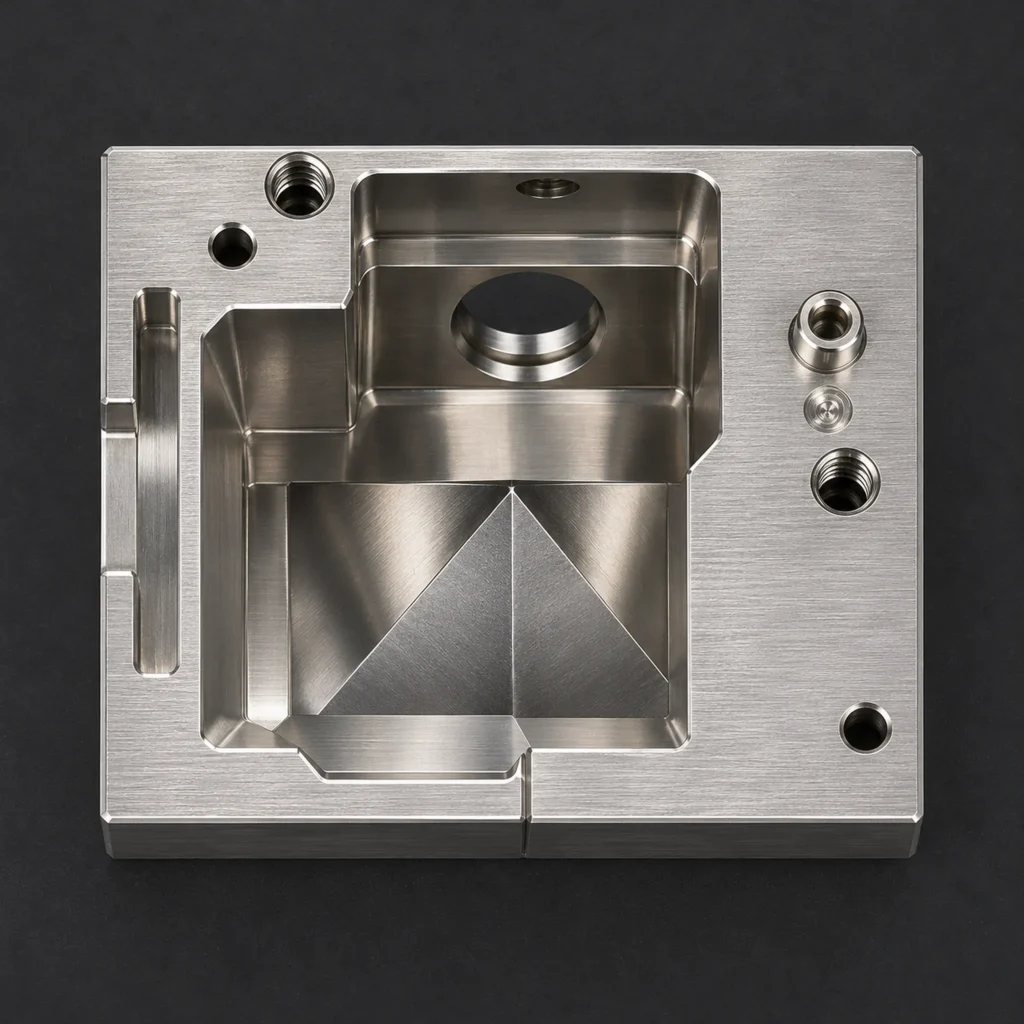
Case 03 | Laser Collimator Housing & Beam Splitter Prism Mount (Photonics Fiber Receptacle)
Multi-Angle Visual Gallery

1. Manufacturing Process & Material Selection
- Core Process: 5-Axis Micro-CNC High-Speed Machining Center (40,000 RPM Spindle) + High-Precision Surface Grinding + Micro-Hole Deep-Drilling + Ultrasonic De-Burring + Cleanroom Electropolishing & ASTM A967 Citric Acid Passivation.
- Material Grade: Medical & Vacuum-Grade Stainless Steel 316L (UNS S31603) / Titanium Ti-6Al-4V
- Engineering Justification: Ultra-low outgassing under Ultra-High Vacuum (UHV <10^-9 Torr); non-magnetic properties prevent beam deflection in electron/laser microscopy; exceptional chemical and ambient resistance.
- Tolerances & Optical Alignment:45°prism seating angle angular accuracy held to ±15 arcsec; fiber optic receptacle thread concentricity ≤0.004 mm; kinematic datum flatness ≤0.002 mm.
2. Structural Features & Manufacturing Challenges
- Compound-Angle Optical Prism Seating Nest (45°/90° True Geometry):
- Challenge: Polarizing beam-splitter cubes (PBS) and dichroic prisms require sub-arcminute seating orthogonality; any slight taper in the pocket floor skews the transmitted laser polarization state.
- Solution: The prism pocket floor and lateral locating datum ribs were precision milled using diamond-coated end mills in a single 5-axis setup, validated by autocollimator optical reflection angle verification.
- Cleanroom & UHV Vacuum Outgassing Compliance:
- Challenge: High-power laser optics (>10 kW fiber lasers) will catastrophically burn if trapped volatile oils or microscopic metal burrs outgas onto optical surfaces.
- Solution: Stringent ultrasonic multi-stage degreasing followed by electropolishing eliminated all microscopic burrs inside blind screw holes. Final passivation removed free iron, guaranteeing zero-contamination cleanroom vacuum packaging.
3. Real-World Applications
- High-Power Fiber Laser Cutting & Welding Heads: Collimating 1064 nm multimode laser beams from QBH/SMA fiber connectors into parallel coherent beams.
- Quantum Optics & Confocal Raman Microscopy: Anchoring polarizing beam-splitter cubes and dichroic mirrors for multi-laser wavelength combining.
See the processes, materials and inspection considerations for optomechanical components manufacturing at BoValley.